Home

Featured Products
Products Catalog
Events Calendar
Global Symposium
Subscribe to our eNewsletter

GRAFTON DBM - Bone Fibers Make the Difference

BioHorizons GRAFTON DBM product line offers the surgeon multiple options depending upon the specific boney defect and the required handling characteristics.  GRAFTON DBM has been proven to be the most osteoinductive demineralized bone matrix (DBM) available on the market.5  In addition to being the most osteoinductive DBM on the market, GRAFTON DBM utilizes demineralized bone fiber (DBF) technology, which has been proven to be more osteoconductive than DBM particulate.1

GRAFTON DBM is processed by Osteotech, the world’s leading processor of allograft bone.  Osteotech’s proprietary processing of GRAFTON DBM is validated for osteoinduction, biocompatibility and viral inactivation; while maintaining non-collagenous proteins that are critical to the attributes of GRAFTON DBM.  GRAFTON DBM products are readily available and eliminate the need for an additional surgical procedure. 

BioHorizons family of GRAFTON DBM products include:

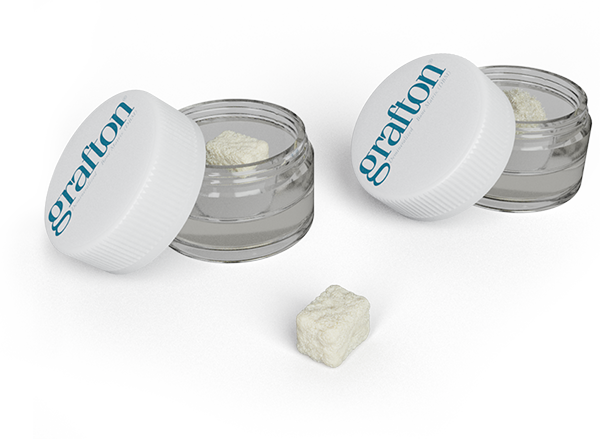
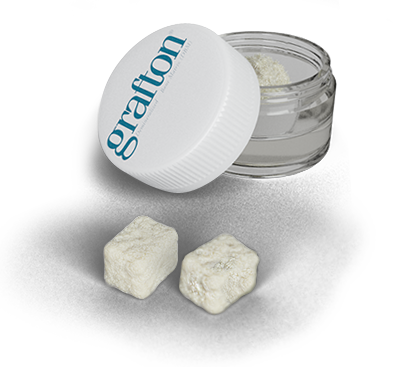
GRAFTON DBM Matrix Plugs
Size: 8mm x 8mm x 10mm (box of 5)

  • 3-D network of DBM fibers
  • Excellent osteoinductivity and osteoconductivity
  • Precision cut cylindrical forms that is easily formed to the boney defect
Grafton Matrix Plugs

GRAFTON DBM Putty in a Syringe
Size: 0.25cc

  • Composed of DBM fibers
  • Delivered directly to the boney defect through a syringe
  • Requires no additional mixing or special preparation
GRAFTON  DBM Putty in a Syringe

GRAFTON DBM Putty in a Jar
Sizes: 0.5cc, 1cc, 2.5cc, and 5.0cc

  • Composed of DBM fibers
  • Easily moldable to boney defect
  • Ideal to be used as a composite graft to deliver mineralized bone (MINEROSS)
GRAFTON DBM Putty  in a Jar

GRAFTON DBM Flex
Sizes: 1.5cm x 1.5 cm, 2.5cm x 5 cm

  • Composed of pressed DBM fibers
  • Flexible - can be shaped or cut to adapt to boney defect
  • Requires no special preparation
GRAFTON DBM Flex

GRAFTON DBM family of products allows for the product to be adaptable to the specific procedure and gives you the required handling characteristics to ensure your expected results are achieved.  Please read below to understand procedures where the properties of GRAFTON DBM can be taken advantage of depending upon the procedure.

Extraction Site Grafting

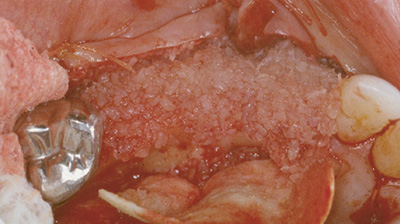
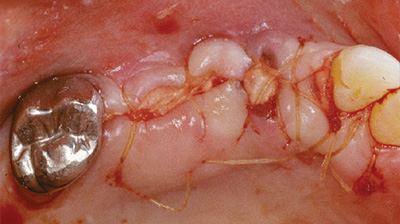
GRAFTON DBM Matrix Plug is a cube of interwoven demineralized bone fibers that is ideal for extraction sites due to its excellent osteoinductivity and osteoconductivity properties and its ability to be placed in extraction site defects.  Matrix Plugs do not require rehydration but can be hydrated in sterile water, or introduced into extraction sites in a dry state and rehydrated with blood. The GRAFTON DBM is loosely packed into the site and will not migrate from the extraction site.

Sinus Grafting

Both GRAFTON DBM Putty and GRAFTON DBM Matrix are excellent options due to their ability to shape to the sinus grafting site.  The Putty or the Matrix is typically combined with a mineralized bone source, such as BioHorizons MINEROSS.  The Putty and the Matrix serve as an optimal solution to deliver the mineralized graft to the site and allow you to receive the benefits of both a demineralized bone graft and a mineralized bone graft.  A human clinical study indicated that a mixture of GRAFTON DBM and a mineralized bone source was equivalent to autogenous bone in sinus grafting as documented by radiographs, histology and implant success rates into the grafted sites.6

Periodontal Regeneration

GRAFTON DBM Putty is a superb choice for the regeneration of bone and periodontal tissues in intrabony defects.  GRAFTON DBM Putty allows you to take advantage of proven osteoinductive properties as well as osteoconductive properties through fiber technology.  A human histologic study demonstrated proof of principal that GRAFTON DBM can induce periodontal regeneration as defined in the 1996 Periodontal World Workshop.7

Ridge Augmentation

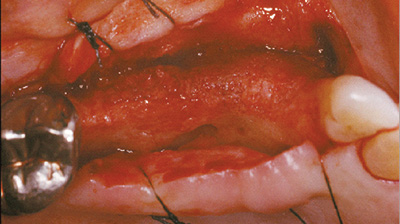
GRAFTON DBM Flex and Putty are frequently used to provide lateral bone augmentation.8 GRAFTON DBM Flex is a flexible sheet of demineralized bone that can be applied whole or cut into strips for precise adaptation to the ridge augmentation site.  GRAFTON DBM Putty can be used to fill the residual defects.

Osteoinductive to Promote Bone Formation

The only definitive assay of osteoinduction remains implantation of the DFDBA in a tissue that otherwise would not form bone, such as in an immunodeficient rat or mouse muscle. A quantitative histologic analysis must be performed of the amount of new bone that formed in association with the implanted DFDBA.2

GRAFTON DBM Putty inserted in muscle tissue in a rat hind-limb following the classic Urist model for osteoinductivity.  Notice the significant bone formation demonstrating GRAFTON DBM osteoinductive activity at 95 days post surgery.

Fibers are More Osteoconductive than Particles – GRAFTON DBM Fiber Technology

In a study conducted at the Emory School of Medicine, fiber and particulate forms of GRAFTON DBM were intentionally devitalized to remove their osteoinductive factors. The devitalized fiber forms, Flex and Putty, displayed a significantly enhanced ability to serve as an osteoconductive graft substitute compared to the particulate form, Gel. Therefore, the bone formation observed in the devitalized Flex and Putty was solely the result of their osteoconductive properties.1 The physical network of entangled bone fibers, found only in GRAFTON DBM, has exhibited a greater capacity for bone formation than particle-based bone grafting materials.

The GRAFTON DBM Process

GRAFTON DBM is processed to the highest standards in the industry by Osteotech Inc., the world's leading processor of allograft bone products.  After extensive donor screening, bone tissue is recovered from tissue banks accredited by the American Association of Tissue Banks (AATB). The bone undergoes a proprietary viral inactivation process that greatly exceeds the levels that known clinically relevant viruses could conceivably contaminate bone. GRAFTON DBM is not terminally sterilized, thus preserving the non-collagenous proteins such as the BMPs.

References

  1. New Formulations of Demineralized Bone Matrix as a More Effective Graft Alternative in Experimental Posterolateral Lumbar Spine Arthrodesis. Martin Jr., G.J., Boden, S.D., Titus, L., Scarborough, N.L., SPINE, 24:637-645, 1999.
  2. Tissue Banking of Bone Allografts Used in Periodontal Regeneration. Committee on Research, Science and Therapy, of the American Academy of Periodontology. Journal of Periodontology, 72:834-838, 2001.
  3. Osteogenic Activity of OP-1 Bone Morphogenetic Protein (BMP-7) in a Human Fibular Defect. Geesink, R.G.T., Hoefnagels, N.H.M., Bulstra, S.K., The Journal of Bone & Joint Surgery, 81-B:710-718, 1999.
  4. Induction of Bone by a Demineralized Bone Matrix Gel: A Study in a Rat Femoral Defect Model. Feighan, J.E., Davy, D., Prewett, A.B. and Stevenson, S., The Journal of Orthopaedic Research, 13:881-891, 1995.
  5. Prospective Comparison of Commercially Available Demineralized Bone Matrix for Spinal Fusion. Wang, J.C., Davies, M.R., Kanim, L.E.A., Ukatu, C.J., Dawson, E.G., Lieberman, J.R., UCLA School of Medicine, Orthopaedic Research Society, 2001.
  6. Early Success of Nonautologous Sinus Grafting in Implant Patients. Neugarten, J.M., Oral Abstract Session 11: Reconstruction / Implants, AAOMS 2000.
  7. Histological evaluation of Grafton in human periodontal intraosseous defects. Hartman G., Mills M., Cochran D., Mellonig, J.B., Submitted to International Journal of Perio & Restorative Dentistry, 2004.
  8. Histologic Analysis of Implant Sites after Grafting with Demineralized Bone Matrix Putty and Sheets. Callan, D.P., Salkeld, S.L., Scarborough , N.L. Implant Dentistry, 9: 36-42, 2000.
  9. Allograft Safety: Viral Inactivation with Bone Demineralization. Scarborough , N.L., White, E.M., Hughes, J.V., Manrique, A.J., Poser, J.W. Contemporary Orthopaedics, 31:4, 1995.

Not available in all countries